

How to Style a Tray
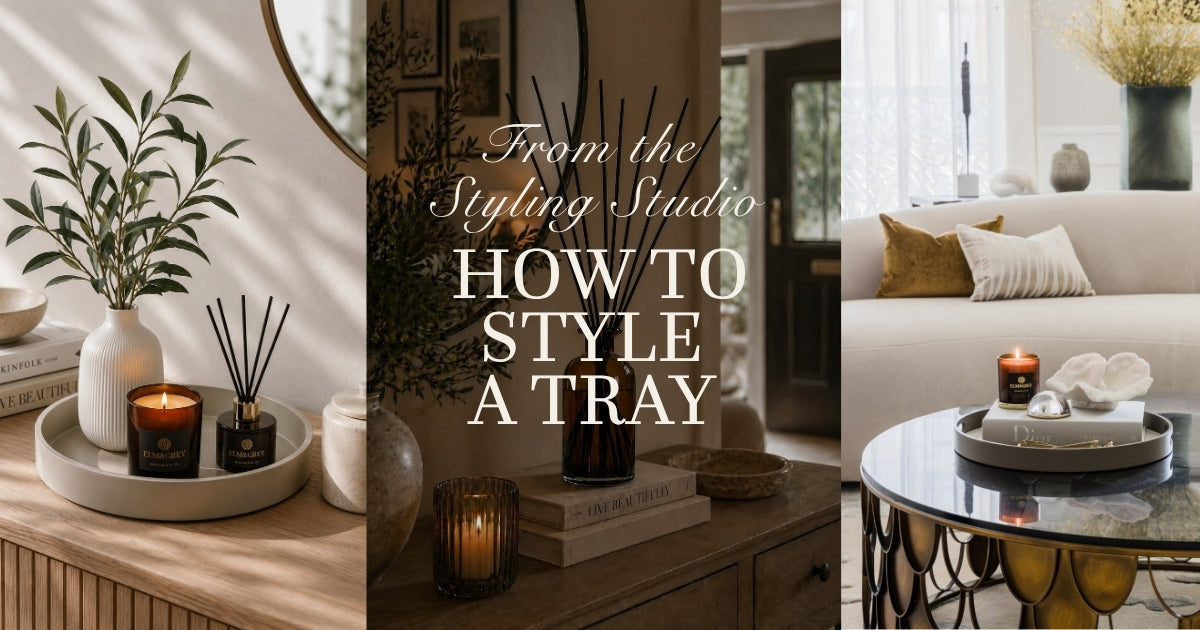
Styling a tray is a skill, though it rests on a few straightforward principles that anyone can use.
A tray brings objects together into a purposeful, aesthetically pleasing arrangement. A candle on its own in the middle of a coffee table can look a little lost. Put the same candle on a tray with a few other pieces and it reads quite differently, as though someone made a choice about it, and the room feels more complete.

Here is the method we use in the studio, and the reason each part of it works.
Start with the surface, not the tray
The tray should sit comfortably within its surface with room to spare. As a rough guide, aim for something that covers around a third to a half of a coffee table, and rather less on a console, where you want the length of the piece to still read.
On shape there are two schools, and both work. Matching the shape of the tray to the shape of the surface creates repetition, which reads as calm and lets the tray settle into the table.


Contrasting them, a round tray on a square table, creates a gentle tension that makes the arrangement more noticeable. Choose calm or choose contrast, but choose deliberately.
A long console or a rectangular table suits a rectangular tray, which echoes the line of the surface rather than fighting it.
Material matters as much as shape. Pick up something already in the room: a wooden tray where there are wooden floors, a lacquered one where there is lacquer or gloss elsewhere. The tray should look as though it belongs.
Three things, not five
Odd numbers group more comfortably than even ones. Three objects will nearly always look better than four, and on most trays three is the right number.
The three should do different jobs.
- Something with height. A vase with foliage, a candlestick, a stem of something from the garden. This stops the arrangement lying flat.
- Something with weight. A stack of two books, a sculptural bowl, a stone or ceramic object. This anchors the group and gives the eye somewhere to rest.
- Something that gives. A candle, a diffuser, a small dish for the things that otherwise gather on the side. This is the piece that earns the tray its place in daily life rather than only in photographs.
If a fourth thing wants to join, ask what it is doing. If the answer is nothing, leave it out.
Vary the heights
The single most common mistake is three objects of roughly equal height sitting in a row. It reads as a shelf rather than an arrangement.
You want a clear tallest, a clear shortest, and something between. Books are the easiest way to solve this, because stacking two gives you a plinth of a few centimetres and lets you lift a bowl or a candle to a different level without buying anything.
Look at the group from where you actually sit. A tray on a coffee table is seen from a sofa, not from directly above.
Avoid a cluttered tray
A full tray looks like storage. A tray with some empty base showing looks like styling. Leave roughly a third of the surface clear, usually towards the front or one side. That gap is what makes the group feel chosen rather than accumulated.
Where fragrance belongs
A tray is the natural home for a candle, and a good one for a diffuser, for reasons that are practical as much as visual.
A candle wants a stable, heat-tolerant base and somewhere it will not be knocked. A tray gives it both, and catches any wax that escapes.
A diffuser wants moving air at around chest height, which suits a console tray far better than a coffee table. Placed low and deep in a room, a diffuser sits in still air with nothing to carry the scent. Placed on a console in a hallway, every person passing lifts the fragrance and moves it through the house.
If you are grouping both, keep the candle to the front where you will reach for it, and the diffuser towards the back where the reeds have room.
Room by room
Living Rooms
- Coffee tables
Round tray, books flat as a plinth, a candle and something green. Seen from sitting height, so keep the tallest element under about 30cm or it blocks the room.
- A word about ottomans
An upholstered ottoman is the one case where a tray stops being decorative and becomes structural. Without one, an ottoman is a footstool. With one, it is a coffee table. What follows is about making that work rather than about how it looks.
Test the top before you choose a tray. Press down in the middle and near an edge. If the surface compresses unevenly, the tray will rock however well it is made. A firm, flat top usually needs nothing more than a rigid tray. A soft or deeply filled one may need a board underneath to spread the weight.
Choose a flat base, not feet. Trays with small feet or narrow rims press into upholstery and leave marks. A full, flat underside distributes the weight across the fabric.
Keep the whole tray inside the upholstered edge. Overhanging a seam or a piped edge is what causes a tray to sit at an angle. If your ottoman is buttoned or tufted, a tray that spans across the buttons is usually fine; one that sits down into the depressions is not.
Raised edges earn their place here. On a hard table a lip is a style choice. On an ottoman it is what contains a tipped cup before it reaches the fabric. Handles matter too, because an ottoman only works if the tray lifts off easily when someone wants to put their feet up.
Move it from time to time. A heavy tray left in one position will compress the filling beneath it and leave a shadow. Lifting it and shifting it slightly every few weeks is enough to prevent that.
On shape, the useful principle is that a tray on an ottoman should introduce a line the upholstery does not already have. A round tray on a square ottoman, or a rectangular tray on a round one, gives the eye an edge to read. Matching the shape exactly tends to disappear.
Since the ottoman itself brings texture, let the tray answer it. A woven or wooden tray against linen reads as warm and natural. A lacquered or metal tray against the same fabric reads as more formal. Neither is wrong, but the tray is the piece setting the tone.
Console or hallway. Rectangular tray, a diffuser, a small dish for keys, and something with height at one end. This is the arrangement guests see first and the one that does most for how a house feels on arrival.
Kitchen island. Keep it simple and keep it moveable. A tray here should lift off in one hand when the surface is needed. Oil, salt and a small plant, or a candle for the evening.
Kitchen counter. A different problem from an island, because a counter is a working surface with a wall behind it. Here a tray is doing containment rather than display: it gathers the things that live out permanently, the oil, the salt, the hand wash by the sink, and gives them an edge so they stop reading as clutter. Keep it narrow, keep it to one side, and leave the working length clear.
Dining table. The advantage of styling a dining table on a tray is that the whole arrangement lifts off in one movement when you lay for dinner. That single fact is why we would always use one here rather than placing objects directly on the table.
Keep the tallest element low, under about 25cm, so people can see across it while eating. If the arrangement is to stay during a meal, a low bowl and two candles works better than anything with height. If it comes off before you sit down, you have more freedom.
Bedside. A small tray contains the things that otherwise sprawl. A candle, a glass, a book. Nothing tall enough to knock in the dark.
Dresser or chest of drawers. This is the surface most often left to accumulate, and a tray is the quickest fix. It works particularly well for the small things that have nowhere else to live: jewellery, a watch, a scent bottle. Choose a shallow tray with a lip, place it towards one end rather than centrally, and leave the rest of the surface clear so the piece of furniture still reads as furniture.
Bathroom. A tray turns necessary clutter into an arrangement. Hand wash, a folded cloth, something in ceramic.
The Test
Stand back and take a photograph on your phone. A camera flattens a room and shows you the arrangement the way a visitor sees it rather than the way you remember placing it.
If it looks crowded, remove one thing. It nearly always looks better.
FAQs
What size tray should I use on a coffee table?
Aim for a tray covering roughly a third to a half of the table, leaving clear surface around it. Matching the tray shape to the table reads as calm; contrasting them makes the arrangement more noticeable. Long consoles and rectangular tables suit rectangular trays. If it is a very large coffee table consider splitting the table into quadrants and use a tray in one of them.
How many things should go on a tray?
Three is usually right. One with height, one with weight, and one that is genuinely useful, such as a candle or a small dish. Odd numbers group more comfortably than even ones.
Can you put a candle on a tray?
Yes, and it is one of the better places for one. A tray gives a candle a stable base, keeps it from being knocked, and catches any wax. Keep it towards the front where you will reach for it, and never leave a lit candle unattended.
Where should a reed diffuser go on a tray?
Towards the back, where the reeds have room, and ideally on a console at around chest height rather than on a low coffee table. Diffusers rely on moving air, so a hallway console works better than a still corner.
How do you style a decorative tray?
Use three objects rather than five: one with height such as a vase or foliage, one with weight such as a stack of books or a bowl, and one that is genuinely useful, such as a candle. Vary the heights, and leave around a third of the tray base showing.
What should you put on a tray?
Something tall, something heavy, and something used. A stem of greenery, two hardback books, and a candle is the simplest arrangement that works on almost any surface. Add a small dish if the tray needs to catch keys or jewellery.
How can I decorate a plain tray?
A plain tray is an advantage rather than a problem, because it lets the objects on it do the work. Add texture instead of pattern: a linen cloth folded underneath, a woven coaster, something in unglazed ceramic. If the tray is very plain, choose objects with more shape to compensate.
Are tiered trays still in style?
Tiered trays have moved out of favour in calmer, more pared-back interiors, largely because they hold a lot of small objects and read as busy. A single flat tray with three well-chosen pieces suits a neutral scheme better and is easier to keep looking deliberate.
How do you style a tray on a dining table?
Keep the tallest element under about 25cm so people can see across it, and favour a low bowl with candles either side. The real advantage of a tray here is that the whole arrangement lifts off in one movement when you lay the table.
Why does my tray look cluttered?
Usually too many objects, or too many of a similar height. Remove one thing, stack two books to lift another to a different level, and leave about a third of the tray base showing.
How do you style a tray on an ottoman?
Choose a tray with a flat base rather than feet, keep it entirely within the upholstered edge, and look for a raised lip to contain spills. Test the top first: if it compresses unevenly the tray will rock, and a board underneath will spread the weight. Contrasting the shape, a round tray on a square ottoman, gives the eye an edge to read.
Will a tray damage an ottoman?
A heavy tray left in one position can compress the filling and leave a shadow in the fabric. Lift it and shift it slightly every few weeks, and choose a tray with a smooth, flat underside rather than narrow feet.