

How to Style Cushions: An Interior Designer’s Guide
Cushions are one of the simplest ways to change the feel of a room.
They can soften a sofa, introduce colour, connect different elements of a scheme and make a space feel instantly more finished. But they are also one of those details that can become surprisingly difficult to get right.
How many do you need? Should they match? Which sizes work together? And how do you introduce colour without making the room suddenly feel busy?
At Elm & Grey, we prefer cushions to feel layered rather than matched. The aim is a room that looks naturally pulled together - comfortable, considered and easy to live with.
Here are the styling principles we use.
Start with the room, not the cushions
Before choosing a cushion, look at what is already in the space.
Your sofa or bed is only part of the picture. Consider the tones in your rug, artwork, curtains, flooring, furniture and other textiles.
Choose one or two colours that already exist somewhere in the room and use these as your starting point.
You do not need an exact colour match. In fact, a slightly different shade often looks more natural.
A warm tan picked up from timber furniture, a soft olive echoed from artwork, or a darker charcoal taken from a lamp or frame can be enough to make the entire arrangement feel connected.
The aim is coordination, not matching.

Mix texture before adding lots of colour
If you love a calm, neutral interior, texture is one of the easiest ways to stop it feeling flat.
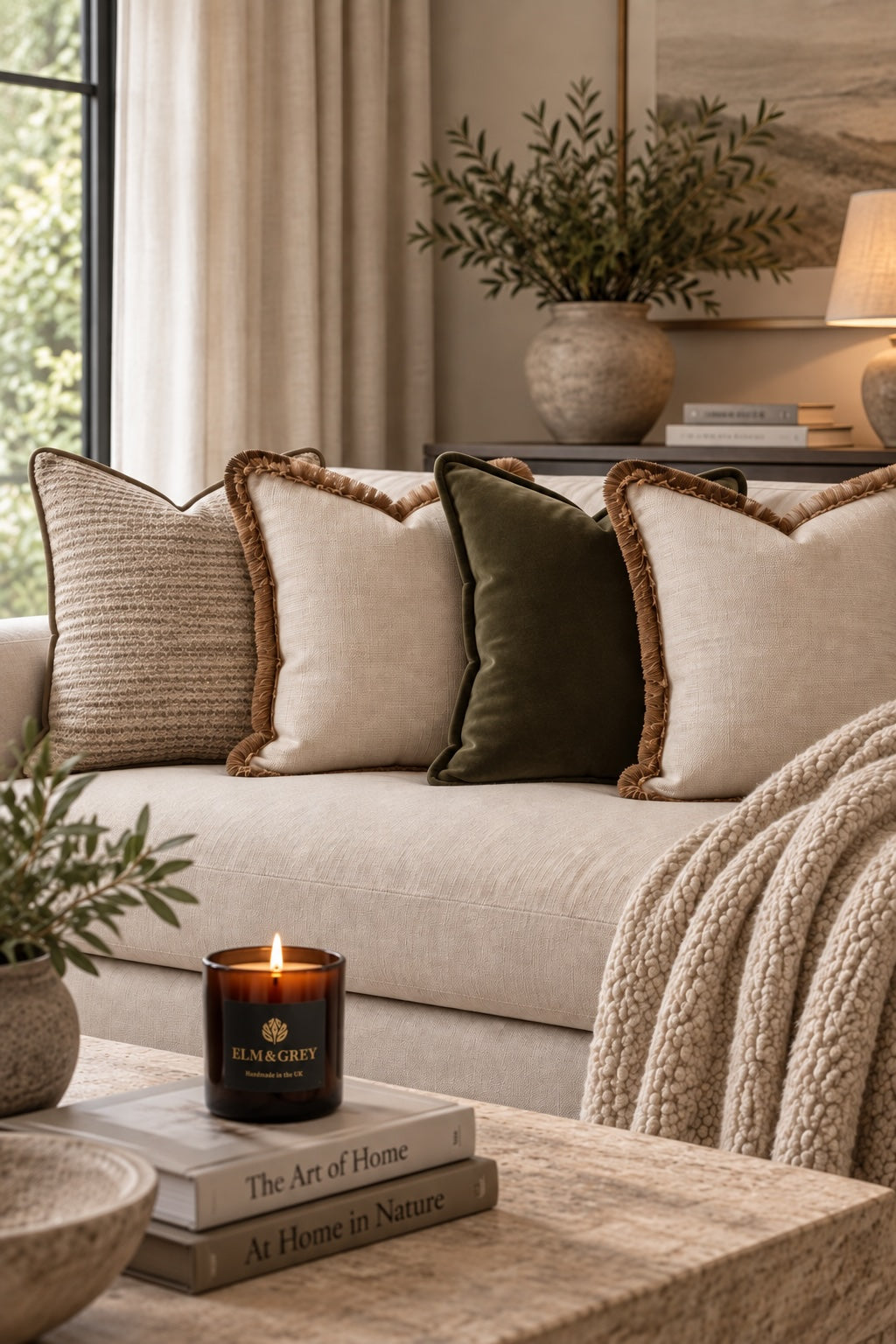
Pair smooth velvet with bouclé, woven fabrics, softly patterned textiles or subtle fringe. Even when the colours are very similar, varying the surface texture gives a room depth.
This works particularly well in warm neutral schemes where cream, stone, oatmeal, taupe and caramel are doing most of the work.
A sofa can remain beautifully quiet while still feeling interesting.
Use different shapes and sizes
One of the easiest ways to make a cushion arrangement look styled rather than simply placed is to vary the scale.
On a standard sofa, we often use 50cm square cushions as the anchors, then introduce a smaller lumbar cushion at the front.
The different shape breaks up the symmetry and makes the arrangement feel more relaxed.
For example, two 50cm cushions paired with a 30 × 50cm lumbar immediately creates more depth than three identical cushions lined up in a row.
On a larger sofa or corner sofa, you can build the same principle outwards with several square cushions and one or two smaller lumbar designs.

How many cushions do you need?
There is no rigid rule, but scale matters.
For an armchair, one statement cushion or a lumbar is often enough.
For a standard sofa, three to five cushions usually creates a layered look while still leaving enough room to actually sit down.
For a large or corner sofa, five to seven cushions often works beautifully. Spread them into smaller groups rather than creating one continuous row.
And remember: more cushions do not automatically mean a more luxurious room. Sometimes a smaller, carefully chosen edit looks much more considered.
Work in loose pairs rather than perfect symmetry
Perfect symmetry can look beautiful in a more formal room, but for the relaxed interiors we love at Elm & Grey, we usually prefer something a little softer.
Try placing two complementary cushions together at one end of the sofa and a different pairing at the other.
They can share a colour, trim or texture without being identical.
This makes the room feel collected over time rather than purchased as one matching set.

Let one cushion do the talking
Every arrangement benefits from a little contrast.
That does not necessarily mean bright colour or bold pattern.
A deep Petrol velvet cushion against cream upholstery, a graphic Onyx weave among warm neutrals, or a rich Carnelian tone layered with bouclé can be enough to give the whole arrangement definition.
Think of this as the cushion that gives the scheme its punctuation.
Everything around it can stay quieter.

How to style cushions on a bed
Beds generally need a slightly simpler approach.
Your sleeping pillows should remain the practical foundation, with decorative cushions layered in front.
Two generous square cushions behind a smaller lumbar is a beautifully easy combination and works particularly well on a double or king-size bed.
Try to avoid covering the entire bed with cushions. The aim is to make it feel inviting rather than overly dressed.
Again, texture matters. A velvet lumbar against washed linen or softly textured bedding can be enough to create a beautifully finished look.
 How to style a reading nook or armchair
Small spaces usually need fewer pieces.
A single generous cushion can soften an armchair beautifully, while a lumbar works particularly well where you want support as well as decoration.
If the chair already has plenty of character, choose something quieter.
If it is plain and neutral, use the cushion as an opportunity to introduce texture, pattern or a deeper colour.

Choose cushions that work beyond one season
We are big believers in buying pieces that can move around your home.
A beautifully made 50cm cushion can sit on the sofa today, move to an armchair next season and eventually find its way onto a bed.
Choosing a considered palette - rather than something tied too closely to a passing trend - makes that much easier.
Warm neutrals, earthy greens, deep blues, natural textures and muted accent colours all layer particularly well across different rooms.
When you do not want to work it all out yourself
This is exactly why we created our curated cushion sets.
Knowing which colours, shapes and textures work together is often the hardest part of buying cushions online. Our ready-styled edits combine complementary designs into complete pairings, trios and larger sofa sets.
We consider the balance of colour, scale, texture and trim so that the cushions feel connected without looking overly matched.
In other words, the styling work has already been done.
Explore our Luxury Designer Cushions, including individual cushions and ready-styled Elm & Grey cushion edits.
A simple rule to remember
Start with the room rather than the cushion.
Pick up one or two tones already present, add texture, vary the scale and introduce just a small amount of contrast.
That is usually all you need to make the space feel beautifully pulled together.
Claire, Elm & Grey