

How to Style a Hallway Console: 7 Simple Ideas for a Welcoming Entrance
The hallway is usually the first room anyone sees and often the last one anyone styles. It tends to be narrow, awkwardly lit, and busy with coats and keys and post. Yet it sets the tone for everything beyond it.
A console table is the piece that makes a hallway feel deliberate rather than functional. Get the styling right and it does a good deal of work for very little floor space. Here are seven ideas we come back to, drawn from years of styling our own hallways and photographing them badly before we learned how.
1. Start with one anchor piece
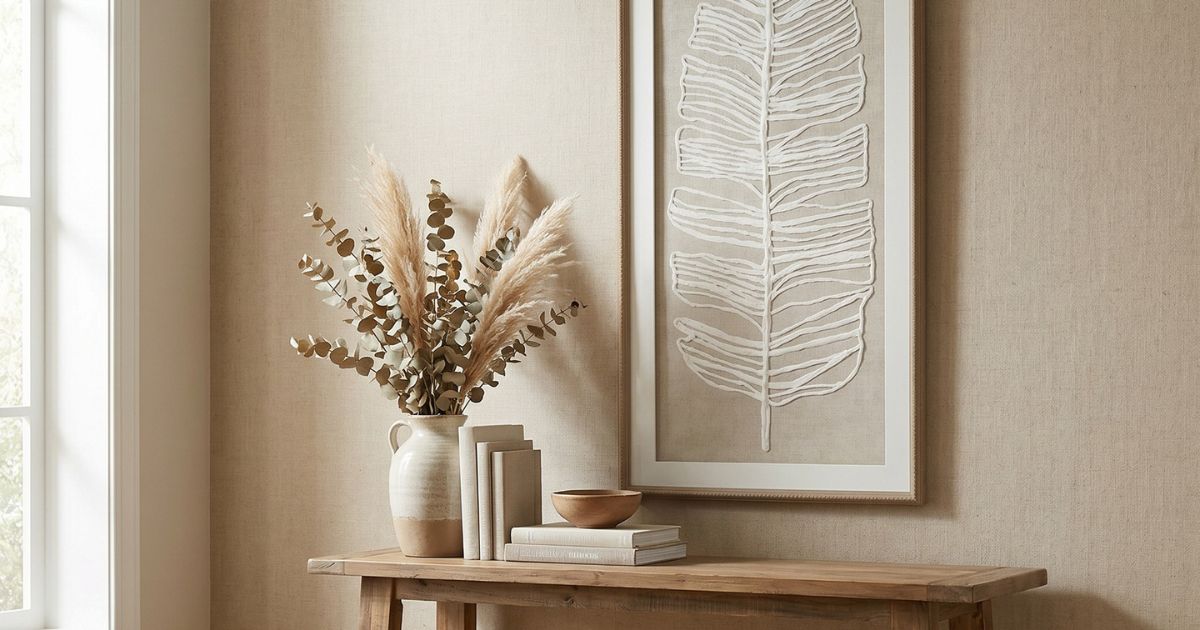
Before anything goes on the table, decide what goes above it. A mirror or a piece of artwork gives the console something to sit against, and without it the styling floats.
A mirror is the practical choice. It bounces light into a space that usually has very little, it makes a narrow hallway read as wider, and it earns its place every time someone leaves the house. Round mirrors soften a hallway full of straight lines. A tall rectangular mirror will exaggerate ceiling height, which helps in a low-ceilinged cottage hallway.
Artwork is the more personal choice and gives you colour to work with. If you go this way, scale matters more than anything else. The piece should be roughly two thirds the width of the console. Anything smaller looks stranded on the wall.
Hang the centre of either at eye level, around 155 to 160cm from the floor, with a gap of 15 to 20cm between the bottom of the frame and the table surface. Close enough that the two read as one arrangement.
2. Create height
The most common hallway mistake is styling flat. Everything on the console sits at the same low level and the whole arrangement disappears.
You need one tall element to draw the eye upward. There are three good options.
A table lamp is the warmest of the three. A hallway lit only from above always feels like a corridor. A lamp at table height changes the quality of the light entirely and gives you something to switch on when you come home in the dark.
Stems in a tall vase bring height and a little movement. Dried grasses, eucalyptus or seasonal branches will last where fresh flowers in a cold hallway will not.
A large reed diffuser does two jobs at once. Our Statement Diffuser has 60cm reeds, which gives real vertical presence, and it is fragrancing the space continuously without you thinking about it. In a hallway, that combination is hard to beat.
Whichever you choose, place it towards one end of the console rather than dead centre. Symmetry has its place but it photographs and reads as formal.
3. Layer objects at different heights
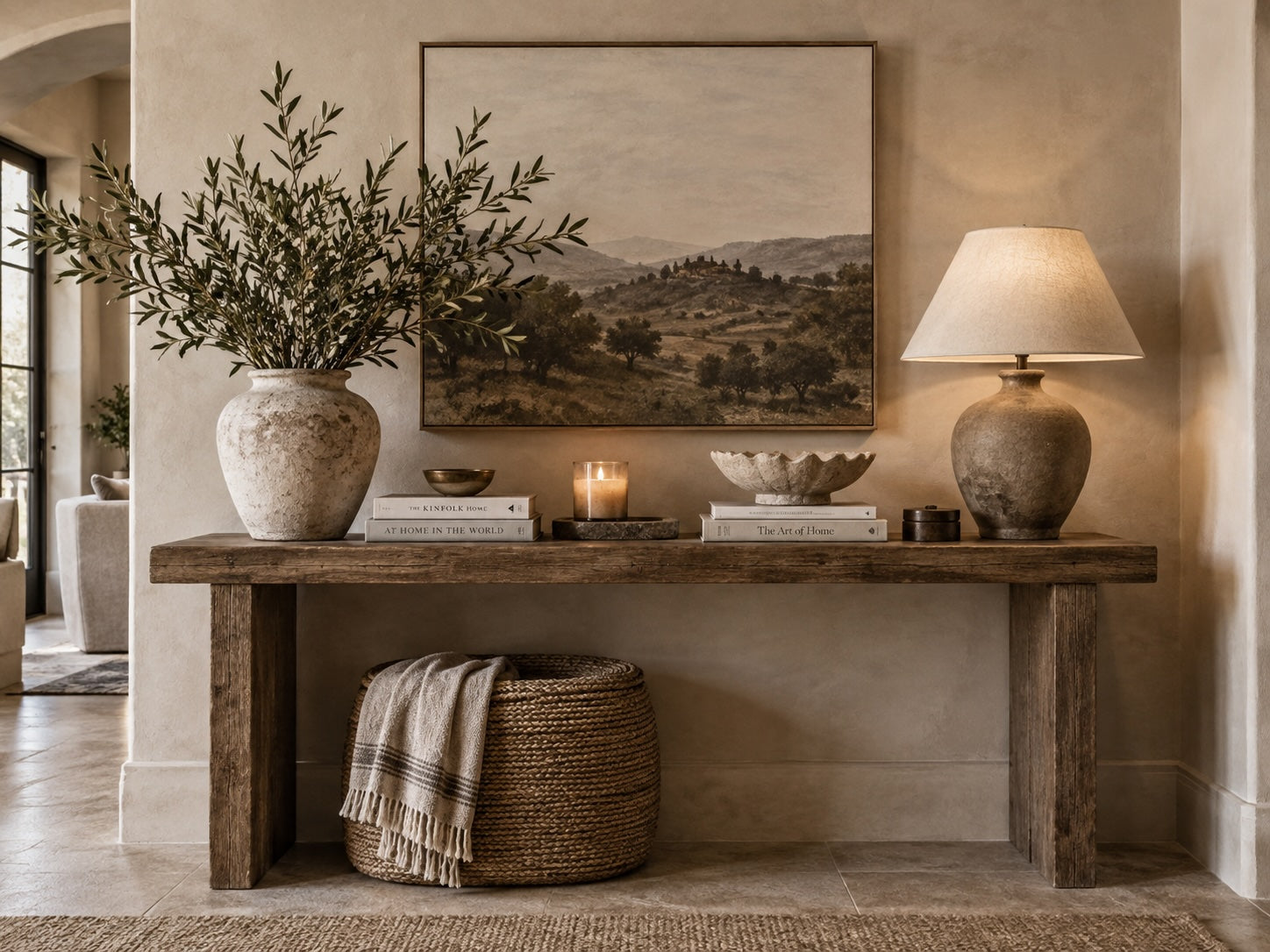
Once you have your tall element, build downward. Aim for three distinct heights: something tall, something medium, something low.
Group in odd numbers. Three objects will almost always look better than four, for reasons nobody has fully explained but everyone recognises when they see it. An even number reads as a pair and pairs look arranged. Odd numbers look collected.
Mix your materials while keeping the palette narrow. Glass, wood, ceramic and a warm metal in the same range of cream, oat, chocolate and natural tones will harmonise even though the textures differ. This is where amber glass is useful, because it holds warmth against a neutral wall in a way clear glass does not.
Cluster rather than space evenly. Two or three tight groupings with clear gaps between them look considered in a way that six evenly spaced objects never will.
4. Use books or trays to create structure
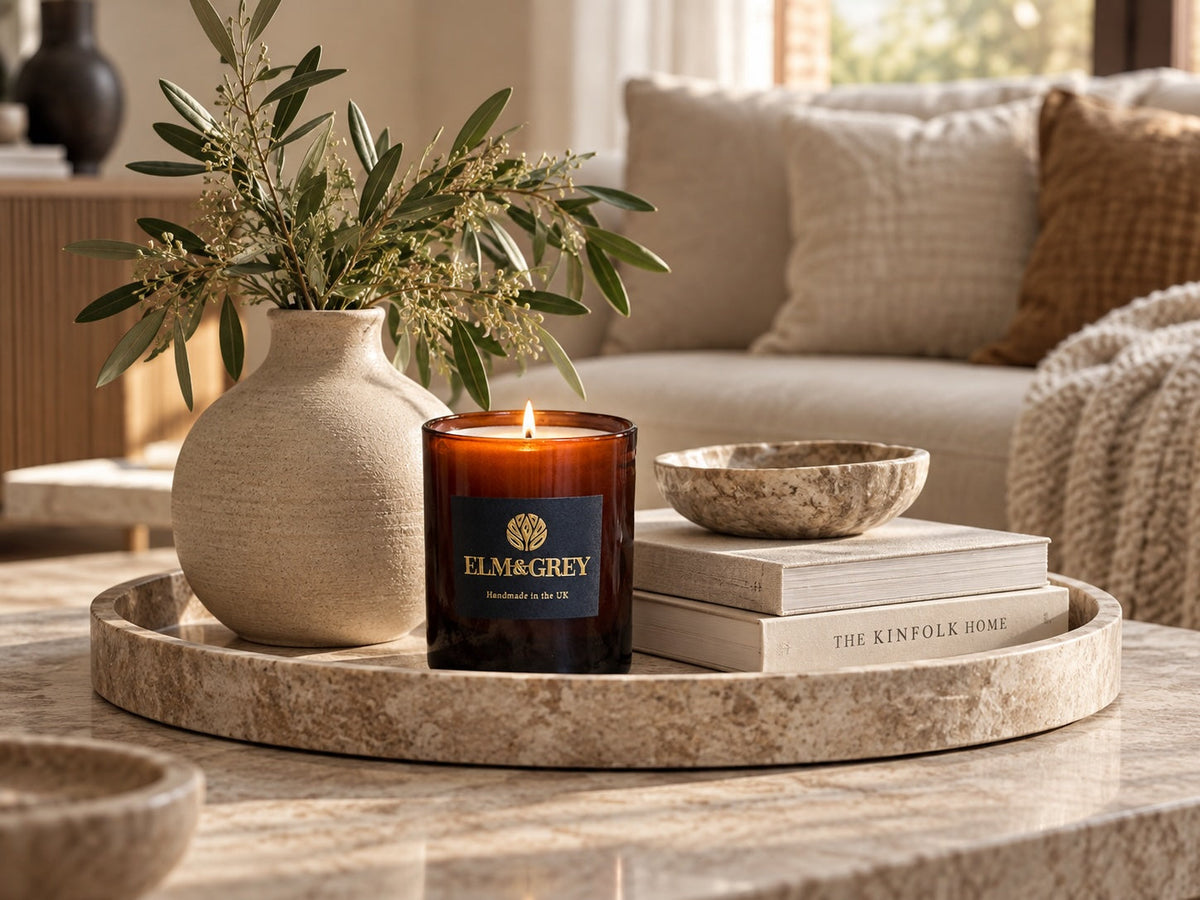
Small objects on a large flat surface look like clutter. The same objects on a tray look like a decision.
A tray contains a group and gives it an edge. It is also genuinely practical in a hallway, because keys, sunglasses and post all land somewhere rather than spreading. A shallow wooden or stone tray suits a neutral scheme and adds a texture you probably do not already have on the table.
A stack of two or three books does something different. It raises a small object to a useful height and adds a horizontal line that stops everything feeling vertical. Hardbacks work better than paperbacks. Remove the dust jackets if the colours fight with your palette.
A bowl or dish is the third option and the most useful of all in a hallway. Keys need a home, and a shallow ceramic bowl gives them one.
5. Add fragrance
This is the idea most people skip, and it is the one that changes how a hallway feels rather than how it looks.
The hallway is the room visitors, pause and then pass through. They arrive from outside with a fresh nose, and the olfactory system responds to change rather than to a steady level, so the step from outdoor air into a fragranced hallway registers immediately. It is the strongest first impression you have, and most hallways waste it.
It is also the room where a reed diffuser makes the most sense. A candle needs lighting and supervising, and nobody sits in a hallway. A diffuser works continuously, which suits a space you pass through rather than occupy.
Two practical notes. Reeds are the volume control, so add more to increase the throw and fewer for something subtler. And a diffuser placed near a doorway, where the air naturally moves, will always read stronger than one tucked into a still corner.
For fragrance, a hallway can take something with presence. Warm resins and soft woods work particularly well because they read as depth rather than as scent. Myrrh and Tonka is the one we use in our own hallways.
6. Leave some negative space
The hardest part of styling anything is stopping. A console table that is two thirds full looks generous. The same table filled edge to edge looks like a shelf.
Leave a clear stretch of surface, ideally at one end. It gives the eye somewhere to rest and it makes everything you have chosen look chosen rather than accumulated.
It is also practical. A hallway console needs somewhere to put a bag down. Styling that leaves no room for actual life gets dismantled within a fortnight.
If you are unsure whether you have overdone it, take a photograph on your phone. A camera is far less forgiving than the eye and shows you immediately what needs to come off.
7. Adapt the styling for narrow or small hallways
Most hallways in British homes are narrow, and the standard advice assumes they are not.
Go shallow, not short. A console of 25 to 30cm depth will work in a hallway where a standard 40cm piece would not. Look for demilune or half-moon consoles, which curve back at the edges and let people past. A wall-mounted shelf is the narrowest option of all and keeps the floor clear, which makes the space read as wider.
Build vertically. When you cannot spread out, go up. A tall mirror, a lamp and a large diffuser take almost no surface area but give the arrangement presence.
Reduce to three objects. A narrow console cannot carry seven things. A lamp or diffuser, a low bowl and one textural piece is enough, and restraint reads as intentional in a small space.
Choose reflective and light-toned materials. Mirror, glass and pale wood bounce what light there is. A dark console in a dark narrow hallway disappears.
Keep the floor clear. Nothing makes a narrow hallway feel narrower than things at ankle height. If you need shoe storage, closed and under the console is the answer.
Bringing it together
The arrangement that works in almost any hallway: a mirror above, a lamp or large diffuser at one end, a tray or bowl holding the small everyday things in the middle, one textural piece, and a clear stretch of surface at the other end.
Five decisions, and the hallway stops being a corridor.
If you would like more on the fragrance side, we have written separately about where to place a reed diffuser and how to choose a home fragrance.
Frequently asked questions
How deep should a hallway console table be?
For a narrow hallway, 25 to 30cm is ideal. A standard console of around 40cm depth needs a hallway of at least 120cm width to avoid making the space difficult to pass through. Demilune consoles are a useful compromise, as the curved shape gives you surface area in the centre while keeping the edges clear.
How high should a mirror hang above a console table?
Hang it so the centre sits at eye level, roughly 155 to 160cm from the floor, leaving a gap of 15 to 20cm between the bottom of the frame and the table surface. This keeps the mirror and console reading as a single arrangement rather than two separate things.
What is the best home fragrance for a hallway?
Hallways suit fragrances with presence, since visitors arrive with a fresh nose and notice scent immediately. Warm resins and soft woods work particularly well. A reed diffuser is usually a better choice than a candle in a hallway, because it works continuously in a room nobody sits in.
How many objects should go on a hallway console table?
Three to five in a standard hallway, three in a narrow one. Group them in odd numbers at varying heights and leave a clear stretch of surface at one end.
Where should a reed diffuser go in a hallway?
Near the doorway rather than tucked into a corner, at around nose height, where the air naturally moves. Moving a diffuser half a metre towards a door can change how noticeable it is considerably.